
Area Codes Serving West Virginia
West Virginia has two area codes, 304 and 681, and both of them cover the entire state. Area code 304 came out of the original 1947 numbering plan, when whole states were handed a single code and the middle digit was a zero to mark that. It stayed the only West Virginia code for the next sixty years. Area code 681 arrived in 2009 on top of it rather than beside it, which is the part that trips people up. There is no northern code and no southern code. There is one map with two codes sitting on it.
Because the codes share their territory exactly, a business in Charleston can hold a 304 line and a 681 line in the same building. Neighbors on the same street can have different codes. A mobile number issued in Beckley this year is as likely to be 681 as 304, while the landline it replaced almost certainly starts with 304.
| Area Code | Coverage | Year Assigned | Overlay Status |
|---|---|---|---|
| 304 | All 55 counties. Charleston, Huntington, Morgantown, Parkersburg, Wheeling, Beckley, Martinsburg, Fairmont, Clarksburg, Bluefield, Lewisburg, Elkins, and every rural exchange in between | 1947 | Original statewide code |
| 681 | The same territory as 304, with new numbers issued anywhere in the state | 2009 | All-services statewide overlay |
Neither code has ever been retired, and no West Virginia number has been forced to change because of the overlay.
West Virginia Area Code Coverage by Region
Mapping codes to places is short work here, because the answer is the same everywhere. Every region of the state carries both codes. Older numbers lean heavily toward 304 simply because they were issued first, and the newest lines in any town are the ones most likely to start with 681. That pattern is about the calendar, not the map.
- Kanawha Valley - Charleston and its ZIP codes from 25301 through 25392, plus South Charleston, Dunbar, St. Albans, Nitro, Belle, Sissonville, and Cross Lanes, all on 304 and 681
- Huntington and the west - ZIP codes 25701 through 25779 along with Barboursville, Kenova, Ceredo, and the Wayne County routes, all on 304 and 681
- North central - Morgantown ZIP codes 26501, 26505, 26506, and 26508 plus Star City, Westover, Granville, and Cheat Lake, all on 304 and 681
- Eastern Panhandle - Martinsburg, Charles Town, Shepherdstown, and Harpers Ferry, on 304 and 681 rather than any Washington area code
- Northern Panhandle and Mid-Ohio Valley - Wheeling, Weirton, Moundsville, Parkersburg, Vienna, Fairmont, and Clarksburg, all on 304 and 681
- Southern coalfields and Greenbrier - Beckley, Bluefield, Princeton, Logan, Oak Hill, and Lewisburg, all on 304 and 681
The Eastern Panhandle deserves a note of its own. Berkeley and Jefferson counties sit close enough to the Washington region that people assume the phone numbers follow the commuting patterns. They do not. A Martinsburg number is a West Virginia number, and it uses the same two codes as a number in Welch.
What a 681 Number Does Not Mean
The overlay produced one lasting piece of confusion in West Virginia, and it is worth stating plainly. A 681 number does not mean a different part of the state. It does not mean long distance. It does not mean the caller is out of state, and it certainly does not mean the call is a scam. All it means is that the number was issued after the spring of 2009, when the new code opened for assignment.
People act on that misreading more than they realize. Calls from clinics, schools, and county offices go unanswered because the code looks unfamiliar, while a spoofed call showing a comfortable 304 exchange gets picked up. Scammers know which code reads as local, which is exactly why the code on your screen is a poor filter. Judge a call by whether the number matches the office's published listing, not by which of the two codes it starts with.
Overlay vs Split in West Virginia
When a code runs out of numbers, regulators pick one of two fixes. West Virginia looked hard at both in 2008. A split would have drawn a line through the state, leaving one side with 304 and moving the other side onto a new code. Businesses objected, and so did residents, because a split forces new signage, new business cards, new letterhead, and reprogramming for alarm panels, medical alert systems, and security gear. The Public Service Commission went with the overlay instead, and the trade was straightforward: nobody changes a number, everybody dials ten digits.
- Overlay
- A fresh code dropped onto territory an existing code already serves. Existing numbers stay put and every local call needs the area code.
- Split
- The old code is kept by one part of the map while a second part is moved onto a brand new code, so a share of the customers have to change numbers.
- Permissive dialing
- The grace window before a new rule bites, when calls still connect the old way and the new way. It ends on a set date.
- Number exhaust
- The point where a code has few enough unused exchange blocks left that regulators have to add capacity.
West Virginia's version was an all-services overlay, meaning the new code applies to landlines, mobile numbers, business lines, and internet-based service alike. Some states have tried limiting a new code to wireless only. That approach was abandoned nationally years ago because it never held up in practice.
Dialing Rule for West Virginia
Ten digits is the rule, and it has been since February 28, 2009. Before that date the state had run a permissive window that opened on July 26, 2008, during which a local call connected with either seven digits or ten. That window closed on February 27, 2009. The following day seven-digit local calls stopped working, and the first 681 numbers went out to customers the month after.
The Public Service Commission still keeps the transition on record.
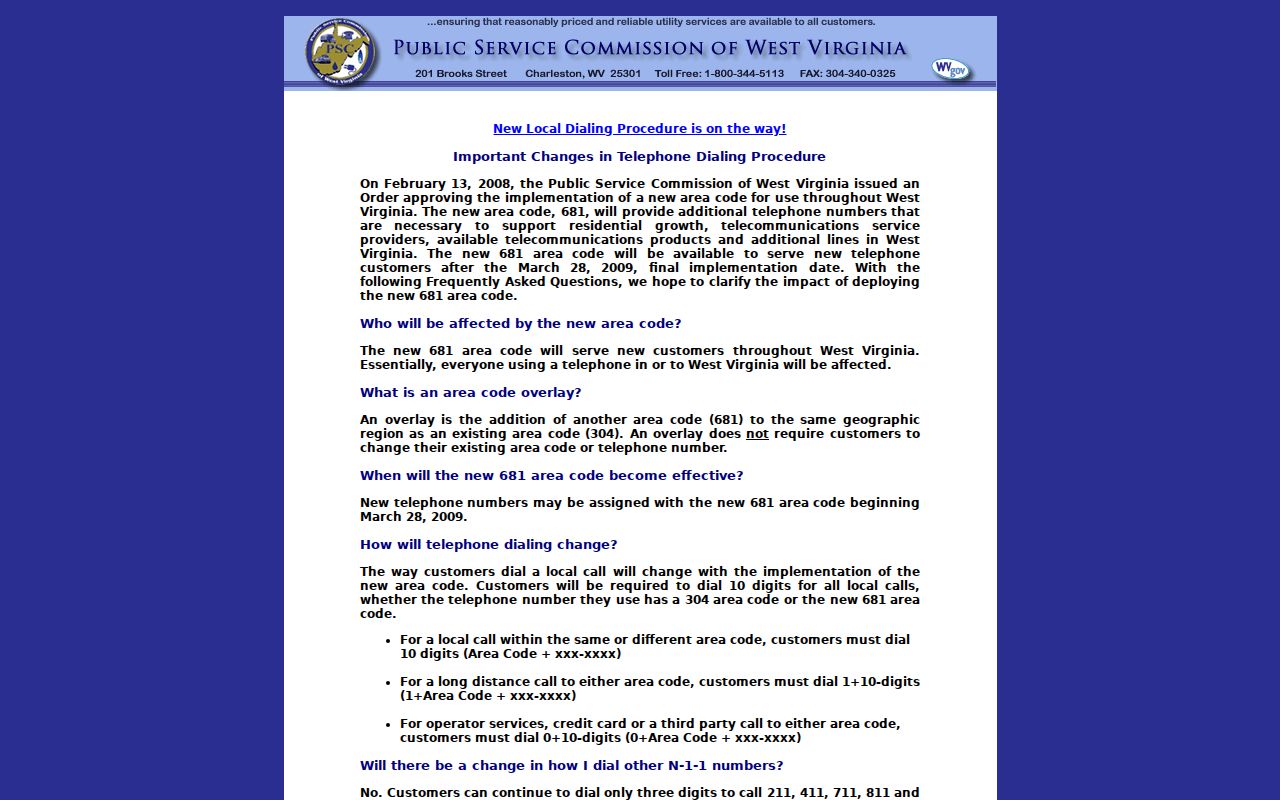
The commission's ten-digit dialing page lays out each date in the changeover and explains why the overlay came before the new code went live. That sequence matters. Ten-digit dialing had to be working statewide first, because otherwise a 681 number would have been unreachable from a phone still dialing seven.
Important: Local calls in West Virginia need all ten digits. A seven-digit call has not connected anywhere in the state since February 2009, and adding the area code is the fix.
Long distance and toll calls may still want a 1 in front of those ten digits, depending on the carrier and the equipment. Older office systems and alarm panels are the usual holdouts. The West Virginia phone codes page covers the rest of the dialing picture, including the short service codes and the star codes that work on lines here.
History of West Virginia Area Codes
The state's numbering history is unusually simple, which makes it easy to follow. One code did the job for six decades. Then wireless phones, fax machines, alarm lines, modems, and competitive carriers all began claiming exchange blocks at once, and 304 started running short. Relief planning turned serious in 2007. Everything after that happened in under two years.
| Year | Event |
|---|---|
| 1947 | 304 assigned to all of West Virginia as one of the original North American codes |
| 2007 | Exhaust planning begins as wireless, fax, business, and VoIP demand eats through 304 prefixes |
| 2008 | The Public Service Commission weighs a geographic split, then approves a statewide overlay after objections |
| July 2008 | Permissive ten-digit dialing opens; seven and ten digits both connect |
| February 2009 | The grace period ends and mandatory ten-digit local dialing takes effect statewide |
| March 2009 | 681 opens for new assignments across the whole state |
Nothing has changed since. West Virginia went from one code to two and stopped there, while several neighboring states have added three or four codes over the same stretch.
Note: The state has never once split an area code, so no West Virginia household has had to give up a phone number over a numbering change.
Local Exchange Prefixes in West Virginia
Since the area code covers everything, the three digits after it carry the local detail instead. That middle block is the exchange, also called the central office code or the prefix, and it is tied to a rate center rather than to a town boundary. Charleston, Huntington, and Morgantown each have their own rate centers, and the exchanges assigned to them are the reason a number can hint at a place even when the area code cannot.
Under 304 the examples are easy to spot. 304-413 is a Morgantown assignment, 304-954 sits in the Charleston zone, 304-962 and 304-963 are Huntington zones, and 304-964 belongs to Scott Depot. The 681 assignments follow the same rate centers, which is why 681-205 and 681-273 are Charleston, 681-204 and 681-286 are Huntington, and 681-209 and 681-668 are Morgantown. Certain exchanges have picked up institutional reputations too, since 304-558 shows up across state government and 304-293 belongs to WVU.
The authoritative list is not a consumer product. NANPA publishes central office code assignment records as compressed downloads sorted by state and code, and a separate explainer page covers how exchange codes and thousands-blocks are handed out. Those files show which carrier received a block, not who holds a given line today.
Future Area Codes Planned for West Virginia
No third code is on the table. Official numbering sources reviewed in mid 2026 show no active relief plan for West Virginia, and both NANPA's map material and the Public Service Commission's overlay page still describe 304 and 681 as the two codes serving the state. Adding 681 roughly doubled the supply of available exchanges, and demand here has not grown the way it has in faster-growing states.
If that ever changes, the process runs in a set order. NANPA tracks how quickly exchange blocks are being consumed and issues a forecast when a code approaches exhaust. Carriers and the Public Service Commission then work through a relief plan, the commission picks the method, and a schedule of permissive and mandatory dialing dates follows. For residents the practical effect of another overlay would be close to nothing, since ten-digit dialing is already the habit here and existing numbers would stay as they are.
Verifying a West Virginia Area Code
Two official references settle whether a code is real and which state it belongs to. Neither one identifies a caller, which is the limit worth remembering before you rely on either.
NANPA keeps a state-by-state map selector for United States area codes.
Picking West Virginia on the NANPA map page confirms the same two codes described above, and the page also links to relief planning material for anyone tracking a forecast. The FCC keeps a plainer numbering reference that explains how codes are assigned and what the agency does and does not control.
Once a code checks out, the next question is who actually holds the number, and that is a separate job. The West Virginia phone numbers page walks through the official directories and reverse-lookup channels that answer it.